Three products in one frame: what the Anex iQ Stroller taught us about mechanisms
A carrycot, a seat and a buggy on one frame sounds like a feature. In engineering it is three products that have to agree on every hinge.
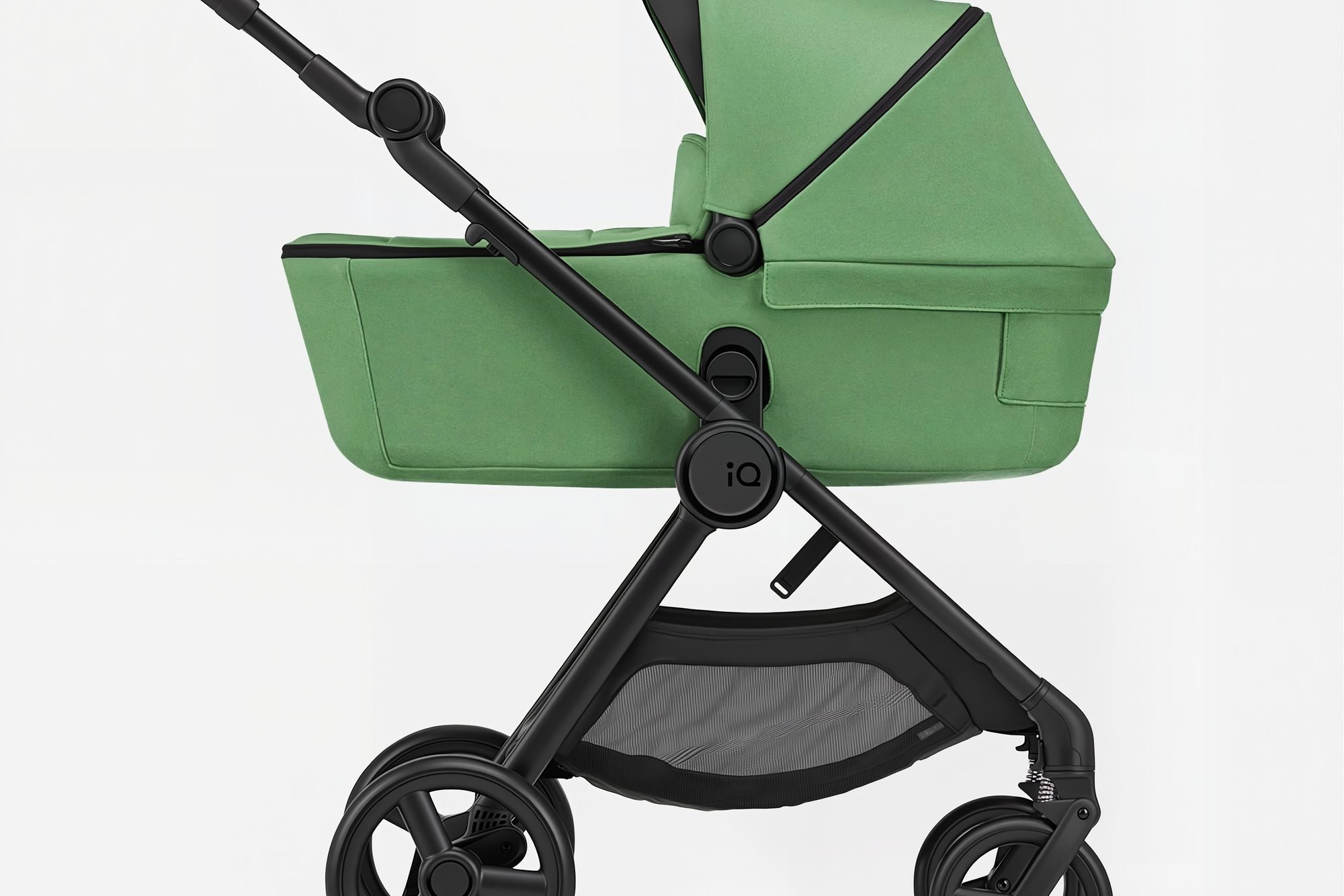
Anex came to us with a clear idea: one stroller for the whole of early childhood. A carrycot for the newborn months, a seat that lowers flat for infants, a buggy for the toddler years, all on a frame that parents keep rather than replace.
The idea is easy to say. The engineering is where it earns its name.
Why "one frame" is the hard part
Every mode puts a different load on the frame. The carrycot wants a flat, stable platform. The seat wants to recline and face both ways. The buggy wants to fold small, with the seat still attached. Each of those is a solved problem on its own. Solving them on the same mounting points, with the same locks, is the project.
Our rule was that switching between modes had to take seconds and had to be obvious. A conversion that is fiddly or unsafe undoes the whole idea, because parents will simply not do it.
What we decided
Shared mounting points. The carrycot, seat unit and buggy use the same interface on the frame. One set of locks to learn, one set to test, one set to certify.
Mechanisms inside the frame. Hinges, locks and suspension are integrated into the frame sections rather than bolted on. This is partly aesthetic: the stroller reads as one clean object. It is mostly practical: fewer exposed parts means fewer pinch points, fewer places for dirt, and fewer components to assemble.
Suspension everywhere, including the fold. Front and rear shock absorbers and a damped folding joint are part of the frame design. The fold in particular is where strollers feel cheap or expensive, and damping it was a small cost for a large difference in how the product feels.
One palette. Frame finish, fabric colours and hardware were chosen as one family, so each colourway reads as a single object rather than an assembly of parts.
The constraints that shaped it
Child-product safety standards fix pinch-point clearances, harness geometry, stability and brake behaviour before any styling decision is made. We treated the standard as the first design input, not the last check.
Weight and folded size pulled the other way. Every mechanism added mass, and every millimetre of folded length mattered. Most of the engineering time went into making mechanisms do two jobs so that there were fewer of them.
What we would tell another team
Combining products is not adding features. It is multiplying interfaces. Before promising "three in one", count the interfaces, decide which ones can be shared, and prototype the lock that has to work in all three modes before drawing anything else.
Anex handled textiles, sourcing and production. We worked from concept through industrial design to mechanical engineering of the conversion and folding mechanisms. The full case study is on the project page.