
Medical instruments that patients are not afraid of: the VisionTech speculum
An ENT instrument that has looked the same for a century, redesigned to light itself, work in one hand and survive the autoclave. What that took.
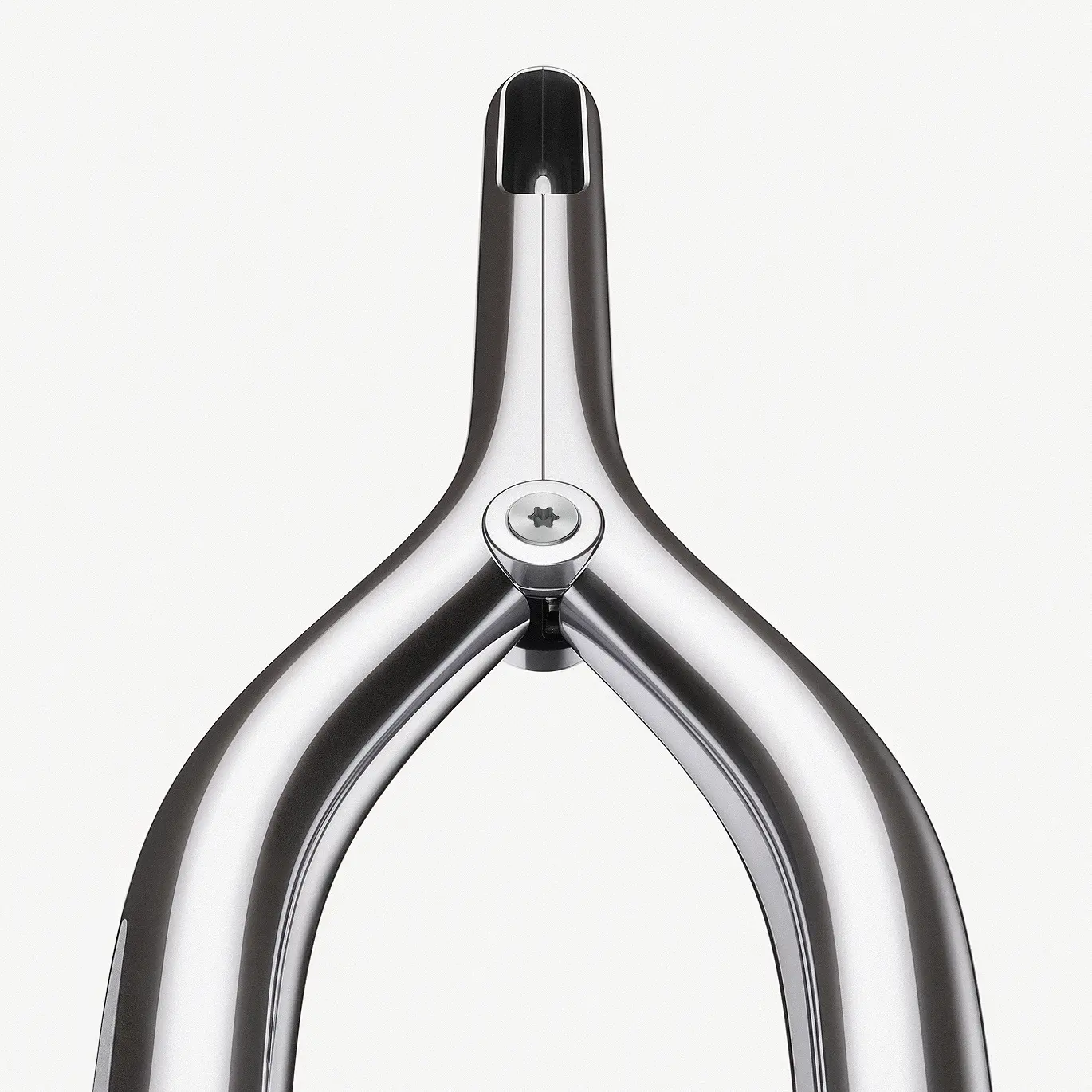
An ENT examination needs two things at once: a speculum to open the nostril and light where the clinician is looking. In practice that has meant a head lamp or a hand-held torch, a second hand, and an instrument whose shape has not changed in a hundred years.
VisionTech asked for a speculum that brings its own light, can be held in one hand, survives the autoclave and looks less intimidating to the patient. The last requirement is the one most medical briefs leave out, and it shaped the product as much as the other three.
Light where the clinician looks
The LED sits at the tip, at the end of a channel that runs up the inside of the handle. The light lands exactly where the examination happens, without a separate lamp and without a shadow from the instrument itself. This was the first thing we prototyped, because if the light did not land correctly nothing else mattered.
Electronics that leave before sterilisation
Everything reusable has to withstand repeated autoclave cycles. Electronics do not. So the LED, battery and electronics are one module that clicks out of the handle. The metal instrument goes through the autoclave; the module stays dry. The interface between them had to be simple enough to use between patients and robust enough to survive thousands of cycles.
A spring you cannot see
Traditional specula carry the return spring between the blades, where it is visible, collects debris and looks like a tool. We moved the spring inside the sculpted handle. The clinician gets a precise, predictable grip. The patient sees a smooth, calm object. Both matter: a patient who flinches makes the examination harder.
One hand
Handle geometry and spring force were tuned so the speculum opens, holds and lights with one hand, leaving the other free. This is where most of the ergonomic iteration went: a few grams of spring force either way changes whether the instrument feels controlled or tiring.
What the medical sector demands from design
Three things we would say to anyone designing a reusable instrument:
- Sterilisation decides your materials and your seams. Choose them first, then design.
- The user is the clinician, but the patient is in the room. An instrument that looks less threatening is easier to use well.
- Prototype the critical function in the real material early. A 3D print tells you about the grip. Only the metal tells you about the spring.
RAAK took the speculum from strategy through industrial design and mechanical engineering to manufacturing support. The full case study, including the constraints we worked within, is on the project page.